(This is the third of a nine part, self-indulgent series about me and Apple Macs. The previous parts can be found here: 1, 2. Strap in, and please keep your arms and legs inside the vehicle at all times. You’ve been warned.)
2006 – iMac
In 2005, the small software company I worked for was acquired by a big software company. This was a good thing; our little software company wouldn’t have lasted much longer without being absorbed by a larger company with deeper pockets and a bigger sales force. As is standard in (some) acquisitions, the deal made to employees was sweetened with a retention bonus, to prevent those who may be averse to working for a larger company (usually the young ‘uns with the startup mentality) from immediately jumping ship, and as a not unpleasant welcome gesture to those old hands amongst us who are more than happy with steady, stable employment. The big company’s retention bonus was generous – without going into specifics, it was a two-parter, paid after 12 and 24 months. The result was that, in October 2006, I found myself with a sum of money with which to be frivolous (convoluting the logic of my at-that-point soon-to-be-mother-in-law’s advice that gadgets could only be acquired for Christmas, birthdays, or with bonuses, I decided that all bonuses must be spent on gadgets. Hello, syllogistic fallacy.) This was a dangerous situation for me to be in.
The 15″ PowerBook G4 was a great machine. Fast, powerful, with a great design, it had all but one thing: screen real estate. By this time, Apple was onto its fourth iteration of its ‘creativity suite’ of applications, iLife ’06, and some of the apps bundled with it were really, really good. iPhoto did an awesome job at editing and cataloging photos; iDVD was a fairly simple, but incredibly useful, DVD creation app; and Garageband was an fantastic entry-level digital audio workstation. All of these apps, whilst usable on a 15″ display, begged for something larger.
Enter the 20″ iMac.
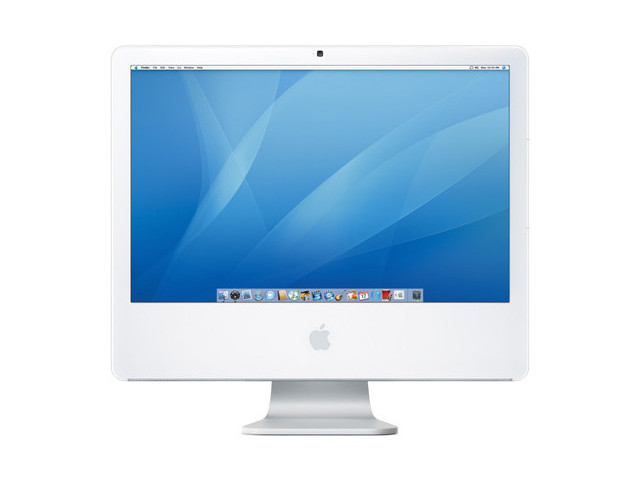
The iMac was noted for its all-in-one construction, with no separate tower. This all started with the earliest CRT-based iMac G3, continuing with the anglepoise lamp-style iMac G4, before settling on the guts-behind-the-display design of the iMac G5. As the iMacs got more refined with each generation, the size of the screen with which it came became larger. From 14″ to 15″, 17″ and 20″, by the time I started to think about an iMac, the top screen size was 24″. I decided I couldn’t quite justify a display of this enormousness, so instead opted for the slightly smaller, yet more than sufficient, 20″ model.
But screen size wasn’t the only thing that my new iMac had going for it. It was the first Mac I owned that had an Intel processor in it, specifically a Core 2 Duo, running at 2.16 GHz. This was a transition away from PowerPC chips that Apple started at the beginning of 2006 with a Core Duo-powered iMac, and finished in November the same year with an Intel-based Xserve. It was a surprising, but much lauded, move to transition from older, slower hardware, to faster, less power-hungry Intel processors. Additionally, Intel processors were more of a commodity than their PowerPC equivalents, and the hope was this would lead to lower prices on Mac hardware. I’m not sure this entirely came to fruition, especially with Apple hardware (still) carrying the unjustified stigma of being disproportionally expensive compared to similar specced rivals, but we Apple fans cling to the tired maxim of getting what you pay for.
So I ordered a tricked out iMac with a 20″ screen, 250 GB hard drive, and 2 GB of memory. I even topped it off with a DVD-writing SuperDrive, and a Mighty Mouse1 to boot. And yes, as is to be expected, the machine lived up to all expectations. It was nice to use a ‘real’ computer again, rather than balancing a laptop on one’s, well, lap, but the iMac didn’t feel like a traditional computer. The guts of the machine were right there tucked behind the display, which was most confusing to certain parental units who couldn’t fathom where I’d stashed the tower. The screen was great, making photo editing or DVD making a cinch, and the machine flew, helping me lay down a selection of musical travesties with nothing but a copy of drum sequencer Doggiebox, a TonePort GX, and a perpetually-out-of-tune guitar. Fun times.
The only seemingly retrograde step when moving to the iMac was the transition from a classy-looking aluminium laptop back to a functional white polycarbonate machine. This irked my for about 15 seconds until I swiftly forgot all about it2.
Meanwhile, the PowerBook G4 was eventually sold on, as usual, this time to a friend of Kath’s, who I believe may have only recently retired the machine3. Impressive longevity.
- Which turned out to be quite rubbish. The nipple wheel thing was atrocious. ↩
- Though my irkage was reinstated when Apple released an aluminium iMac. A classy looking machine, if ever I’ve seen one. ↩
- Interestingly, Kath passed on taking the PowerBook G4 as a hand-me-down. She preferred the 12″ iBook G4 that preceded it, and didn’t let go of that until I relinquished hold on a white, 13″ MacBook a couple of years later. But let’s not get ahead of ourselves just yet… ↩

 What Did You Do, Ray?
2 thoughts on “Macs and Me: Part 3”