2016 – A Media Review

If there’s one thing that this year’s paltry list of things I’ve watched, read, and to which I’ve listened tells us, it’s that having a baby destroys any semblance of free time one may have previously had. The numbers of books read and movies watched have dipped to levels so low as to be previously unheard of. (However, I suspect if you checked the graph for numbers of nappies changed or numbers of hours of sleep lost to calming a grizzly baby, the graph would be exactly equal in magnitude yet precisely opposite in trend.) Here, then, is the piss-poor list of media stuff I’ve consumed this year.

Movies

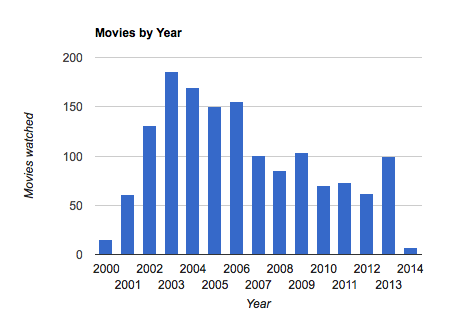
This year, I watched 52 movies, at a rate of one movie every 7.0 days, or 0.14 movies a day. This is down from 2015 numbers of 69-5.2-0.18, and a new low, taking over from 2012’s 62-5.9-0.17. The high remains 2003 at 186-2.0-0.51. Here, check out the latest graph:

movies-watched-2016

(Don’t worry about 2000 and 2001 – the data for those years is incomplete.)

So the list for 2016 is as follows:

  • The Good Dinosaur
  • Star Wars: Episode I – The Phantom Menace
  • Star Wars: Episode II – Attack of the Clones
  • Star Wars: Episode III – Revenge of the Sith
  • The Martian
  • Star Wars: Episode IV – A New Hope
  • Star Wars: Episode V – The Empire Strikes Back
  • Star Wars: Episode VI – Return of the Jedi
  • The Last Patrol
  • Star Wars: Episode VII – The Force Awakens
  • Zootropolis
  • Kingsman: The Secret Service
  • Captain America: Civil War
  • Harry Potter and the Philosopher’s Stone
  • Garden State
  • Gravity
  • Deadpool
  • Harry Potter and the Prisoner of Azkaban
  • Night at the Museum
  • Night at the Museum 2
  • Ghostbusters
  • Batman v Superman: Dawn of Justice
  • Zootropolis
  • Straight Outta Compton
  • The Big Lebowski
  • Sherpa
  • Everest
  • The Walk
  • The Resurrection of Jake ‘The Snake’ Roberts
  • Spooks: The Greater Good
  • Green Room
  • Kubo and the Two Strings
  • The Intern
  • The Nice Guys
  • Bridge of Spies
  • Steve Jobs
  • Frankenweenie
  • Citizenfour
  • The Big Short
  • 10 Cloverfield Lane
  • My Scientology Movie
  • Coraline
  • The Revenant
  • The Secret Life of Pets
  • Weiner
  • Concussion
  • X-Men: Apocalypse
  • Star Trek Beyond
  • Rogue One: A Star Wars Story
  • Rogue One: A Star Wars Story
  • Harry Potter and the Goblet of Fire
  • Elf

Yes, Rogue One is on the list twice, because I saw it twice. Yes, I’m counting it twice, because this is my list and I can do what I want (and also because I paid cold, hard cash for it twice). Highlights were: most definitely Rogue One (loved loved loved it); I love a good espionage thriller, and Bridge of Spies, with the always-watchable Tom Hanks was a pleasure to watch; The Revenant was brutal and brilliant; Kubo and the Two Strings had me weeping in the cinema; and The Last Patrol, the final part of Sebastian Junger’s war documentaries (following the brilliant Restrepo and Korengal).

If it had actually been released this year, my film of the year would have been The Martian. I loved it. It was smart, it was funny (Damon gots comedy chops, yo), and free of the jingoistic bullshit that similar “Let’s get our man back” films have. The science was refreshingly plausible, and the whole ride didn’t disappear up its own existential a-hole like, say, the interminable Interstellar. I liked it so much I even bought the t-shirt. However, given this year’s viewing of the flick was a rewatch, it can’t claim the title of my fave film of the year, so I guess we should raise a glass and toast Rogue One, which has that honour – for it is an honour – bestowed upon it.

Also of note is the boy and I working through the Star Wars and Harry Potter series. Whilst he loved all seven Star Wars movies (he’s not seen Rogue One yet – I don’t think he’s ready for it), he tended towards the prequels – there’s something about Anakin that drew him in, and he was more interested in his rise and fall than in Luke’s rise and non-fall in the original trilogy. I can only guess that that means my son is going to turn out to be a serial killer. And I totally forgot that Revenge of the Sith has some brutal crispy-fried Anakin scenes towards the end that are totally unsuitable for a five-year-old, and that I should have edited out. My bad.

The Harry Potter movies went down a treat with him too, most likely due to a younger, more relatable set of characters (if you actually can relate to young wizards, which I think most 5/6-year-old kids think they can). It’s only watching these films through a kid’s eyes that it becomes apparent that there are some scary things in there. Not the obvious stuff, like the basilisk in Chamber of Secrets (which is obviously fantastical), but the werewolf/dog animagus stuff in the already-dark, Cuaron-directed Prisoner of Azkaban, or the resurrection of the nose-less Voldemort in Goblet of Fire (it was the nose more than anything that got him). I know the films are 12/12A, and I know showing them to a 6-year-old is probably borderline, but I made sure we watched them during the day, with the curtains open and the lights on, the audio set to night mode to reduce the dynamic range, and frequent stops to reassure that it was all made up and in no way real. I’ll take the same approach when I show him Cannibal Holocaust this year.

Books

I read a hilariously poor number of books this year. That number was five. Five books in twelve months. Yikes. My excuse is that I usually read during my lunch breaks at work, but with Mrs S. being on maternity leave for most of the year, I’ve been heading home for lunch with her and child 2. Anyway, here’s the list:

  • When the Professor Got Stuck in the Snow – Dan Rhodes
  • Batman: The Dark Knight Returns – Frank Miller
  • The Ocean at the End of the Lane – Neil Gaiman
  • Harry Potter and the Cursed Child – J.K. Rowling, John Tiffany and Jack Thorne
  • Arabian Sands – Wilfred Thesiger

My BfaM and all-round good egg Matt bought me the Dan Rhodes book, and I loved it – despite being a massive fan of Dawkins, it was obvious that his obediently scientific and objective world view and borderline acerbic manner was ripe for exaggeration and skewering, and Rhodes nails it. I don’t get why The Dark Knight Returns is hailed as the masterpiece that it is – maybe it was ground-breakingly original and unique in the 80’s, but to me it was just confusing and dull. Hey-ho. The Neil Gaiman book was a 99p-er on sale on Amazon that I took a punt on and, not really enjoying the much-vaunted American Gods (yeah, sue me…), I didn’t expect much. I think that worked in its favour, as I ended up liking it quite a lot. The Harry Potter script was interesting – the story was a reasonably enjoyable romp, but perhaps I’m not sufficiently down with reading scripts to fully ‘get’ it in its entirety. Maybe a novelisation would help.

I’ve wanted to read Arabian Sands since finishing A Short Walk in the Hindu Kush, by Eric Newby, a book for which I’ve previously expressed my love. The last few paragraphs of Hindu Kush catalogue the protagonists’ encounter with Thesiger in the Hindu Kush whilst they’re inflating their air-beds for the night. Thesiger calls them a pair of pansies for partaking of such comforts. Reading up about him, it appears Thesiger has every right to hold that opinion: Arabian Sands is his account of his time crossing the Rub’ al Khali, the Empty Quarter in Saudi Arabia, a number of times. It chronicles in great detail his trips to map out previously uncharted territory, his relationships with a number of Bedu tribes, and the unbelievable hardships he suffered on his travels. Whilst there’s a lot of names – tribes, tribes folk, Wadis etc. – that have a tendency to go in one ear (um, eye?) and out the other, his terse writing is a wonderful catalogue of a way of life and of a people that, even at that time, was in real danger of disappearing, with the advent of technology and the interminable hunt for more and more oil. Not the easiest read, but worth it.

Hopefully, 2017 will give me more of a chance to read, so I’m hoping this list next year will be greater than a measly five books in length.

Music

Yowzer, this’ll be a short section. I bought precious little music this year, but of the few I did buy, here’s my irrelevent verdict:

The new Metallica album, Hardwired… To Self Destruct, is far better than I expected it to be, after the St. Anger and Death Magnetic. In fact, I totally dig it. Deal with that. The new Helmet album, Dead to the World, is as disappointing as the last few have been – momentary glimpses of genius (riffs, solos, lyrics etc.) are subsequently sullied by Page’s shitty vocals. I can’t even say I’ve listened to the new Weezer (The White Album) and Deftones (Gore) records enough to pass comment on them. Same with the new Dinosaur Jr. (Give a Glimpse of What Yer Not) and Neurosis (Fires Within Fires). There’s a new Planes Mistaken for Stars album out, Prey, that no-one told me about and so I haven’t listened to that yet. I hope it’s great. The Baroness album, Purple, was last year, right? Shame, that’s a great album.

Yeah, I don’t have much to say about music this year, as with most years of late. Read into that as you will.


So there you have it. In brief summary, I liked Rogue One, and the new Metallica album, but didn’t read many books. To be honest, that was just about all I needed to write, rather than 1500 words of self-indulgent waffle. Perhaps I’ll do that for next year’s review, then. You’ll just have to tune in then to find out. Same Bat-time, same Bat-channel.
Review: The Places In Between – Rory Stewart

My fascination with Afghanistan continues. The Places in Between, by the now-Member of Parliament Rory Stewart, is a record of Stewart’s walk from Herat to Kabul in Afghanistan in early 2002, mere months after the commencement of the War in Afghanistan. It’s a fascinating journal of an 800 km walk between a series of town and villages, in the dead of winter, across territory often still marginally controlled by the Taliban. Stewart’s letters of recommendation from earlier villages’ headmen are often the only things between a bed for the night and being left outside in the snow to fend for himself. Relying on the Islamic tradition of hospitality, he nearly always has a floor to sleep on, some bread to eat, and a roof over his head every night.

He meets a bewildering array of characters, and it’s clear he’s done his homework: a Persian speaker, he successfully manoeuvres himself into and out of situations as need be, knowing how many effusive greetings to offer to a stranger at any given time, or how to confuse parochial and threatening locals with wider-world talk.

But the villagers and headmen and soldiers and officials aren’t the only stars of this captivating travel journal. He takes in the cream of the architectural and geological wonders of the area: from the domes of Chist-e Sharif, to the empty niches of the recently-bombed Buddhas of Bamiyan, to my personal favourite, the minaret of Jam. Conservation worries aside, reading his account of climbing to the near-top of the minaret, with nary a soul around, gave me chills, and made me desperate to swap places with him, 12 years in the past, if only for a second.

There are also stark reminders of the ongoing war/invasion/occupation. Burnt husks of villages, destroyed by the Taliban. Families missing vast swathes of members, killed by the Taliban. The vast, empty caverns in Bamiyan where the Buddhas once stood. The accurate and anguished recounting of these traumas by the people whom Stewart encounters only reinforces the conditions and the time in which he’s walking, only months after the invasion started.

The Places in Between is a fantastic read. Riveting, illuminating, harrowing. And if you don’t have a tear in your eye when Stewart recalls the final fate of Babur the dog, an unwanted gift that soon becomes his valued travel companion, then you’re a brute. Read this book as soon as you can.

The Places in Between – Rory Stewart

The Great 2013 Round-up

Another year, another self-aggrandizing, look-at-my-opinion-on-things, round-up post. And nearly a month late, too. Winner.

In 2013, I managed to make triple digits in the number of movies I watched for the first time since 2009. After a poor year of only 62 movies last year (0.17 movies/day, or 5.89 days between movies), I managed to hit exactly 100 flicks this year (0.27 movies/day, or 3.65 days between movies) with a last minute, New Years Eve viewing of The Hobbit: An Unexpected Journey. Whilst it’s pleasing to hit the big Three Figures for the year, I’m nowhere near the glory days of the early- to mid-2000s, where digits of 150 were the norm. I even have a graph to prove it:

Movies watched

Highlights of the year:

  • The Hobbit: An Unexpected Journey – Naysayers be damned: I loved this. Sure, I haven’t read the book, so I have no idea how much Peter Jackson ruined the source material, or stretched it beyond its means, but I don’t care. I was more than happy to spend another three hours of my life back in that world, even if it was a tad over-lit and TV show-ey in 3D HFR. Still, it was quite the spectacle.
  • Gravity – Amazing. A pulse-racing, eyeball-popping feast from start to finish. I smell Oscars.

In fact, I probably don’t need to go any further than that. Sure, there were some other great flicks out this year, but I’m a sucker for a spectacle movie, and The Hobbit and Gravity delivered in spades. However, other new (or, at least, new to me) flicks in which I partook and enjoyed include: Zero Dark Thirty (rough in places, but compelling nonetheless), Django Unchained (new to me, utterly enthralling), Captain Phillips (who doesn’t love a good Tom Hanks flick? Losers, that’s who), Saving Mr. Banks (can’t get enough of that Hanks, and Emma Thompson is a dream), Prisoners (the bleakest, most compulsive two hours I spent this year), Argo (Affleck is the new Hanks) and Silver Linings Playbook (I’m also a sucker for a fucked-up love story).

Being laid up for a few weeks in the middle of the year, I managed to find the time to visit a couple of blasts from the past, classics that everyone rolls their eyes at when they hear I haven’t seen them. It quickly became apparent that I’d missed out on some doozies. Butch Cassidy and the Sundance Kid was excellent. The Godfather is every inch a classic, from first to final frame. 2001: A Space Odyssey is a rambling, self-indulgent, preposterous waste of two hours. Bullitt is slow, but redeemed by that car chase.

So not a bad year for movies. As for books, I only managed to get through twelve of them. I don’t need a calculator to work out that that’s only one a month. Disgraceful. My progress was held up with the 2½ months it took me to read Andrew Ross Sorkin‘s Too Big To Fail which was, fortunately, excellent. I made the mistake of reading the first three of the trilogy of five Hitchhiker’s Guide to the Galaxy books, which I fear I’m not the target audience for. I’m sure my 15 year old self would have lapped them up, but the 35 year old me got a touch bored by it all. But the best book by far that I read this year (and which I’ve mentioned before) was A Short Walk in the Hindu Kush by Eric Newby, which played straight into my continuing obsession with all things Afghanistan. It’s as much a story of companionship and a record of mid-20th century British attitudes and humour as it is a travel book, and it’s so much more interesting as a consequence. Lovely.

As for music, my intake of new stuff in 2013 continued its slippery slope down. Highlights were the new Jetplane Landing album, Don’t Try, which was stunning; the new Modern Life is War disc, Fever Hunting, which was very much a welcome return; While A Nation Sleeps, by Boysetsfire, which went some way to atoning for the sins of The Misery Index; Blood Drive by ASG, which is a new one to me, but is, as my friend Matt remarked, right up my street; and finally the new Alice in Chains album, The Devil Put Dinosaurs Here, was a continuation of the post-Staley AIC, and if you don’t mind post-Staley AIC, then this was quite lovely.

So that’s about it. I’m certainly no devourer of new stuff, as I used to be, so my choices tend to be limited and conservative, but no less enjoyed and appreciated as in days of yore.

Review: A Short Walk in the Hindu Kush

‘God, you must be a couple of pansies,’ said Thesiger.

A Short Walk… is the story of a couple of ill-equipped, frightfully British chaps who decided they wanted to climb a remote, as-yet-unconquered peak in the north-east of Afghanistan. The quote above is the final line of the book, uttered by famed explorer Wilfred Thesiger, whom they encounter on their return from their adventure, who catches them in the act of inflating their air-beds.

Whilst their inexperience and naivety leads, as expected, to all manner of difficult and dangerous situations, the story is told with quintessentially British humour and wit. Infinitely readable and most enjoyable, it played right into my current, and bewildering, fascination with Afghanistan. Tragically, whilst reading I attempted to track Newby and Carless’ journey around the Panjshir Valley and through Nuristan on Google Maps, with the help of the crude maps included at the end of the book which, whilst not always successful, made the stories a touch more real and tangible.

If either travel writing or Afghanistan is your thing, read this book.

A Short Walk in the Hindu Kush – Eric Newby

Review(s): A Non-Fiction Round-up

After Gatsby put me off reading ‘classic’ fiction, indeed fiction in general, I’ve decided to go on a non-fiction rampage. I maintain an Amazon wishlist of non-fiction books that I’d like to read, should time permit, that I’ve seen mentioned in one of the hundreds of news feeds I superficially scan every day in Google Reader, and as I’m too lazy to scroll down the list, I ended up just reading the topmost additions, which happened to be the following:

Manhunt: From 9/11 to Abbottabad – the Ten-Year Search for Osama bin Laden – Peter Bergen

These kinds of books play right in to my still-present boyhood fantasy of being some kind of spy or secret agent (though, if I had the choice, I’d still prefer to be an astronaut). It goes in to great detail about the movements of bin Laden pre- and post-9/11 and the herculean intelligence efforts that went into hunting him down. A worthwhile read, if you’re into that sort of thing.

Inside Job: The Financiers Who Pulled Off the Heist of the Century – Charles Ferguson

An epic treatise on how everything went to shit in the financial crisis of 2007/2008. If you liked the documentary of the same name, but lamented the lack of a thousand more examples of really shitty people and practices, and simply wanted more financial acronyms, then this is the book for you. Read it if you want to get a well-informed insight, or if you just want to get plain old angry at banking shysters fucking up the world.

The Buddhas of Bamiyan (Wonders of the World) – Llewelyn Morgan

For some strange reason, I’ve been mildly obsessed with the Buddhas of Bamiyan (and the Minaret of Jam, since seeing it on a Dan Cruickshank show) since they were destroyed in 2001, so this book was an obvious choice. Morgan does a pretty good job at recounting the history of the area, why Bamiyan was so important in years gone by, and why two Buddhist icons were allowed to exist for so long in the middle of a country controlled by the Taliban. If I had the chance/balls/time/money (choose three), I’d love to go to Afghanistan and see all this first hand – Morgan paints an evocative picture that makes it difficult to not want to. However, having none of those four means I’m content with his book instead.

Pathfinders: The Golden Age of Arabic Science – Jim Al-Khalili

Strangely, this book was recommended to me by the author of the previous book, Llewelyn Morgan, in a brief Twitter exchange. And what a recommendation, though not for everyone, I appreciate. A crazy-detailed history of Arabic (and not-specifically-Arabian – a distinction Al-Khalili explains and encompasses in his history) scientific advancements over a several hundred year period. He seems to be attempting to put right an oft-quoted scientific timeline of Greek science -> Dark Ages -> Renaissance by illustrating how much further Arabic scientists and philosophers advanced the scientific cause in those apparent Dark Ages. The key players, al-Khwārizmī, al-Bīrūnī et al., are portrayed as peers, or even superceders in terms of actual advancements made, of their Greek and Renaissance cousins. Again, a fascinating read, but provides the greatest return to fans of Arab history, science history or history history (choose two).

So that was my non-fiction run to end the year, all bar Jake Humphrey’s The Inside Track, which was a simple concession to my twin love of Formula 1 and books that can be lazily read with absolutely no thought or understanding required. Guilty as charged.

Review: The Great Gatsby – F. Scott Fitzgerald

The Great Gatsby – F. Scott Fitzgerald

I’ve deleted and rewritten this ‘review’ a couple of times now. In its previous incarnations, I’d waxed lyrical about classic novels and context, and whether Gatsby was sufficiently universally themed to transcend my asynchronous reading. I’d mused on the comparison of new vs. old money that Fitzgerald describes, on Gatsby’s accrual of wealth via shady means, on love, on revenge, until I suddenly got a whiff of what I was writing, and erased it permanently. What an ass! I was attempting to write a review in the manner of how I thought I ought to be writing a review of The Great Gatsby, when it suddenly struck me that I didn’t give a shit about all that nonsense. It occurred to me that I thought that the book was only, wait for it, OK, and that I ought to write that instead.

Now me labelling something as simply ‘OK’ isn’t necessarily a bad thing. I was lucky enough to find myself in Rome a while back and, searching for an amazing coffee (feel free to insert your own ‘When in Rome…’ gag here), we came across a little cafe near the Pantheon called Tazza d’Oro, which many of the guidebooks labelled as “the best espresso in Italy”, and other similarly ridiculous hyperboles. On a high after experiencing probably my favourite thing in Rome, maybe even the world, the Pantheon, we wandered around the corner and excitedly took a table at the cafe. Well, whilst we both took a table, I was the only one who did it excitedly; Kath hates coffee, so I was flying solo in my coffee giddiness. I ordered the obligatory, and awaited its arrival with bated breath. What was it going to be like? How different from the shit I got served in Starbucks back home could it be? Would it make me piss unicorn tears and shit rainbows, like I hoped? Well, the coffee arrived, looking so very conventional in its little china espresso cup. Lulling me in to a false sense of security, I assumed. Not wanting to reveal its splendiferous hand too early, I guessed. With a trembling hand (not really), I raised that little cup to my lips and, in the split second before tasting it, I inhaled deeply to get a spoiler of what wonderment I was just about to taste. It smelled like… coffee. Yup, coffee. OK, maybe not quite as pungent as the shit you get in Starbucks, but it didn’t smell like god’s farts. Which I assume are awesome.

The tasting soon followed. It tasted like… coffee. Yup, coffee. OK, maybe not quite as bitter and after-tastey as the shit you get in Starbucks, but it didn’t taste of god’s… well, you get the picture. It tasted like a really good espresso. But, crucially, it didn’t taste like I imagined the best espresso in Italy should taste. Oh, it was probably the best espresso I tasted that holiday, and better than any espresso you can get in high street coffee shops (though James would argue that Laynes has the best espresso around, and I’m quite a fan of Opposite), but there was no gustatory fanfare and ticker-tape parade, no choir of angels exalting this taste sensation. Kath eagerly (not really) asked me how the coffee was. “OK,” I replied. Which it was. It wasn’t the greatest espresso I could imagine, so it couldn’t be described as “amazing”, or “mind-blowing”, so I was left with “OK” when ascribing it a rating.

So now that I’ve calibrated my review-o-meter for you, back to The Great Gatsby. It was OK. For a book that’s been described as “the second best English-language novel of the 20th Century,” (thanks, Wikipedia), I was expecting fireworks and rainbows and “You’re The Best” playing in my head constantly whilst reading it. Nothing of the sort, unfortunately. I’m sure the old money/new money conflict is as pertinent today as it was then, but I didn’t really care. Much is made of the hedonistic and shallow nature of Gatsby’s partygoers, and maybe that was revelatory back in the ’20s, but ten minutes of any shit-bag celebrity reality TV show will tell you the same. Sure, Gatsby’s an enigma, and I was interested in the onion-like peeling away of his many layers, from confident and mysterious socialite to insecure and unhappy, to a love-struck puppy, but that’s a relatively well-told story, and this version didn’t tell me anything new. (Also, for some reason I couldn’t get the image of Terry-Thomas out of my mind when thinking about Gatsby, whose massive gap-between-the-teeth is quite off-putting when you’re trying to concentrate.)

I guess this is always a problem I’m going to encounter when reading old books, or watching old films. Without the ability to disregard all subsequent derivate works of art, the originals that inspired will never actually seem original. It’s a weird anachronism where the more recent interpretations become the gold standard against which the originals have to be measured. Maybe I’m just too lazy to try and appreciate the value and the original inspiration contained in the classics but hey, there’s only so many hours in the day, and I’m far to idle and apathetic to delve any deeper. So sue me.

Review: The Sign of the Four – Arthur Conan Doyle

The Sign of the Four – Arthur Conan Doyle

If you follow the link above to the Amazon page where you can buy this book in its Penguin Classic format, you’ll notice that book is listed under the title ‘The Sign of Four’. This should tell you all you need to know about this book. That the title can’t be universally agreed upon would usually be a good indicator that there’s no particular affection for it. The Amazon reviews, however, imply otherwise. Strange.

In my unrefined view, it’s a by-the-numbers detective story, with a healthy dollop of plot over-complication, and just a soupçon of Basil Exposition-esque thirty-pages-too-many at the end. Yes, it introduces the important character of Mary Morstan, Watson’s future wife, and yes, we get further example of Holmes’ brilliant deduction, but I had trouble maintaining interest for the entirety of the novel. And was it only me who was disappointed by the seeming cop-out of using a dog to do some detective heavy-lifting, half way through? Whilst Holmes professes that there are multiple ways to track the suspect in question, and the dog just happens to be the quickest, we’re never told what these other ways are, and I came away feeling a little short-changed.

And yes, I’ll say it, I found this book a bit boring. With no uncertainty in Holmes’ analysis, the process is very linear. There’s no trial and error; it’s always A to B to C and there’s the bad guy. I realise that’s the essence of Holmes, but it can make for unexciting reading.

But anyway, the Amazon reviewers all love it, so I’m obviously in the wrong. One positive I have taken away from the two novels so far is the relationship between Holmes and Watson. My main education in Holmes thus far has been the BBC show, and the Guy Ritchie movies. In the former, Holmes comes across as quite the dick most of the time, especially in his interactions with Watson. In the latter, the relationship is played with a more ‘buddy cop’ vibe. It’s pleasing to find the novels portraying the relationship as somewhere between those two – Holmes is a master at his craft and doesn’t suffer fools gladly (indeed, he treats substandard detectives somewhat mockingly), but he doesn’t seem to extend that douchebag behaviour to Watson. He never seems to get exasperated at Watson for not following the seemingly logical set of steps he took to reach a particular conclusion, and sometimes takes time to explain his reasoning (to us, in reality, via the medium of Watson). Additionally, there are knowing glances and in-comments between the two protagonists that Guy Ritchie has seemingly latched on to and exaggerated to form the basis of the relationship between his Holmes and Watson, no doubt to play to the strengths of his actors. Maybe.

Anyway, I think I’m going to have to tap the short stories next in my Holmes mission, as I can’t endure any more long-form disappointment right now. Onward and upward…

Review: A Study In Scarlet – Arthur Conan Doyle

A Study In Scarlet – Arthur Conan Doyle

I suspect like many people who are currently working their way through The Complete Stories of Sherlock Holmes, my recent interest in Sherlock Holmes has partially come about as a result of the two Guy Ritchie Holmes movies, but mainly due to the Stephen Moffat/Mark Gatiss modern interpretation, Sherlock. So good is the Moffat/Gatiss Sherlock, especially series two, that I was driven straight to The Complete Stories to find out the origin story, if you will.

And boy, what a challenge. OK, so I’m in no way comparing my mission of devouring the Conan Doyle back catalogue as in any shape, way or form as monumental (for there is no better word) as my BFaM Matt’s The King Long Read epic, but still, The Complete Stories clock in at 1408 pages of relatively small print. Well, it’s a mission for me, at least.

So I start at the very beginning, which many consider a pretty average place to start, all things considered. The Holmes canon consists of four novels and 56 short stories. Chronologically, there’s two novels to start, then the other two interspersed amongst all the short stories. The book I’m reading (both hardback and Kindle – who says men can’t multitask?) has the novels up front, then the short stories afterwards. This is disappointing, as the consensus (including The Complete Stories editors’ notes) seems to be that the novels (at least the first two) are a bit crappy, and Conan Doyle only hits his stride with the short stories, defining the Holmes we know of today.

A Study In Scarlet is first up, then. It’s the origin story of Watson meeting Holmes: the characters are introduced and developed, detective and logic skills are thrown in, and personality quirks and idiosyncrasies quickly become entrenched; all this set against the backdrop of a particularly puzzling crime. And so it passes that clues are discovered, reasoning and deduction occurs, false leads are pursued (though mostly by the Scotland Yard detective buffoons who Holmes so likes to mock), all of which leads to the miraculous apprehension of the perp at the end of part one. Miraculous is the right word, as Holmes’ arrest of said criminal occurs out of the blue, with no real prior reference to him. Fortunately, part two of the book takes us 35 years prior to the setting of the story, to the frontiers of the West in America, a setting in to which Mormon frontiersmen are introduced, along with non-believers, forbidden love, and revenge, and fleshes the back story out quite nicely.

The weaving of the two parts of the story into a coherent whole is quite neat – at first the disjoint between the two seemed jarring, but I got on board with it quite quickly, and grew to enjoy it. I think I suffer from being too forgiving when reading, as I really quite enjoyed this. As an introduction in to the Holmes canon, consider me hooked. If the short stories are, as alleged, much better than this, I await them eagerly.

Review: Pantheon – Sam Bourne

Pantheon – Sam Bourne

OK, I’ll admit it. I’m a fan of trashy, Dan Brown-style, fiction. Anything with a slightly preposterous plot, involving a murder and/or a conspiracy and I’m in. When I first heard about Sam Bourne, he was sold as “the new Dan Brown!”, or “better than Dan Brown!” Tragically, this was enough to get my attention.

It was only after I picked up his first book that I realised Sam Bourne was the pseudonym of Guardian columnist Jonathan Freedland. Interesting. Whilst superficially his first four books are very much in the Dan Brown vein (albeit far better written), it was book number three, The Final Reckoning, that made me pay more attention to him. The basic premise of the book, that of a team of avenging Holocaust survivors traveling the world murdering Nazis, is apparently based in fact. This instantly renders the book, and the author, more interesting to me. Fact is always stranger than fiction, and fiction based on fact is surely the strangest of them all.

And so Bourne’s fifth book, Pantheon, appealed to me in the same light. The MacGuffin, a man travelling to America during World War II to search for his family, leads to a larger plot that, again, is based in fact, and makes for fascinating reading, of both the book, and the inevitable Wikipedia trawl afterwards. Sure, the fast-paced page-turning parts of the book are familiar, bordering on formulaic, but I don’t mind that when they’re building towards a bigger picture. It’s the stuff that’s rooted in truth that’s the most fascinating and unsettling.

So yeah, I liked this book. It’s contrived in places and ends poorly, but for a page-turner, it’s perfectly acceptable.