Macs and Me: Part 2

(This is the second of a nine part, self-indulgent series about me and Apple Macs. The previous part can be found here: 1. Strap in, and please keep your arms and legs inside the vehicle at all times. You’ve been warned.)

2004 – PowerBook G4

When last we saw our hero, he/I had just purchased his/my first Apple computer, an iBook G4, and we had to suffer his/my dramatic gushings about how wonderful it was. (I shall now cease with the insufferable third/first person thing.)

The white plastic iBook G4 was a wonderful machine, a perfect introduction to the world of Apple computers (and, indeed, to Apple Computer, as it was still known back then). However, after using it for nearly a year, it started to feel not quite right. Sure, the white, glossy plastic exterior looked awesome against a consumer product market that was still predominantly grey or beige. And yes, with a 12″ screen, it was super-compact and portable and easier to tote around. But compared to my 3rd generation iPod (Classic), with its shiny metal back, and my iPod mini, with its brushed aluminium shell that screamed of classy industrial design, the iBook looked, well, cheap. Yes, I realise that this kind of a thought entrenches me well within the alleged snobbery that we Apple fanbois1 are supposed to partake in, sneering down our noses at the sad, blocky, beige contraptions that the unwashed masses tippety-tap away at, whilst we enlightened ones clickety-click away on our chiclet keyboards, encased within slick, laser-cut, aluminium shells, whilst being continually blown by hotties. Tragically, this image of we Mac users isn’t entirely true – some of us don’t actually use chiclet keyboards2. But Apple has a habit of making you, the consumer, expect more of a product. It’s no longer sufficient that a device is simply good enough – continued use of Apple devices make you expect a product that is exemplary, and forever improving. For the most of us, whilst every Apple product we buy we’re blown away by and seemingly most content with, there’s always a version that’s more powerful, more aesthetically pleasing, slightly further along the curve towards perfection. MacBook Airs are wonderful machines, but boy, I’d like a MacBook Pro with Retina Display. The iPhone 5c is an unbelievably good phone, but just look at how much better the iPhone 5s is. There’s always an increment.

And thus it was with the iBook G4. It was a great machine, but dear god, look at that aluminium PowerBook G4. Sure, it was pretty much the same processor generation, but twice as quick. Memory? Same amount, but faster. Storage? Twice as much. And, oh, the design. An aluminium case, brushed, that was about a third slimmer than the iBook. The backlit keyboard, which I’d convinced myself was a selling point, but the number of times I actually put that feature to good use I could count on no hands. So in November 2004, just 12 months after picking up the iBook, I was back in Computer Advantage once again, shopping for shiny. This time, I plumped for the 15″ model (despite there being a comparable 12″ model on the market), and I just didn’t know what to do with the acres of widescreen desktop real estate at my disposal. It was truly a wonderful machine3. And, due to some weird pay-it-forward kind of deal, my iBook trickled down the family chain to my wife, to serve as her introduction to the world of Apple products4.

But I’ve not drunk sufficient Kool-Aid yet to not realise the machine had flaws. Most gadgets do. Of all the Apple products I’ve had over the years, and it’s they who’ve come closest to perfection, not one of them has achieved that lofty goal. The 1st generation iPod nanos scratched easily. The iPhone 4 couldn’t make phone calls. The 3rd generation iPad (the first with a Retina display) was slow and hot. The iPhone 5‘s antenna band looked pristine and new for about 10 seconds, before it seemed to attract obvious dings and scratches by the truck-load. In the case of the PowerBook G4, or at least mine, it ran hot periodically, and when the fan kicked in to compensate it sounded like a plane taking off. The clever retracting lid latch mechanism that uses magnets and springs to extract and retract the latch when the lid is closed and opened crapped out on me in no time (first the latch bent, then decided to not engage at all.) I’m not the only one – John Siracusa went into his usual great detail about this very issue in this article at Ars Technica. And, as usual with aluminium cases, it seemed to scratch very easily. I don’t know if this is true — that it scratched more easily that my plastic iBook, or just that the iBook hid the damage better.

Notwithstanding those probably minor niggles, the PowerBook G4 was a truly great machine. Fast and powerful, with a design that was leagues apart from anything else on the market, this was a machine I was destined to keep for years. Surely.


The postscript to this particular story is that yes, spoiler alert, I did eventually get rid of the PowerBook, but it went to a good home with a graphic designer friend of my wife, who used the shit out of it over the years. I think it might actually still be in operation in some fashion, nearly a decade after it was first released. Now that’s longevity. But I bet the lid latch still doesn’t work properly.


  1. Ugh. No, really, ugh. When I’m emperor, use of the word ‘fanbois’ to describe ‘people who like and buy Apple products’ shall be punishable with no less severe treatment that death by bunga bunga. 
  2. Boom. I’ve still got it. 
  3. I suspect I shall be saying this about each of the machines I wax lyrical about in this nine-part opus. 
  4. A world that she, like me, hasn’t yet left. 

Cheilectomy Diary, Day 241

(At some point, I’ll head back and fill in days 1-240, but for now, here’s the entry for day 241 in my cheilectomy diary.)

241 days ago, I went into hospital for a cheilectomy, a relatively straightforward procedure (or so my surgeon assured me) to remove a bone spur on the top of big toe joint on my right foot. This post isn’t aimed at anything other than, should some nervous or hesitant potential operatee stumble across it via a Google search, to attest to the efficacy of the procedure1.

I’d had problems with my big toe for some five years prior to my operation, the usual fare for someone suitable for this procedure: stiffness of the toe, pain when walking any distance, inflammation, altered gait, shoes abnormally worn down etc. I’d previously been referred to a podiatrist who had run me through the usual list of increasingly-invasive treatments: orthotic shoe inserts, steroid injections, bone spur removal, joint fusion, and finally joint replacement. I opted for the easiest, least painful choice on the list, and had some orthotic inserts made for my shoes. They were quite uncomfortable to begin with and, to be honest, I’m not sure they did much for me. Nevertheless, I stuck with them for a number of years, getting them replaced as and when my odd gait wore them down, all the while not really noticing any less pain or discomfort.

Finally, I decided I’d had enough. Or, more accurately, Kath decided she’d had enough of me hobbling around like a decrepit old 90-year-old. Back to see the doctor I went, and was referred once again, but this time to an orthopaedic surgeon, the quite awesome Mr. Harris. He decided that I was an ideal candidate for a cheilectomy, the third entry on the aforementioned List Of Painful Procedures™. He didn’t think my case warranted fusing the toe joint (good), and there was no real talk of joint replacement (really good), so all that was left was  ‘chipping bits off until it moves better’. Sounds… delightful.

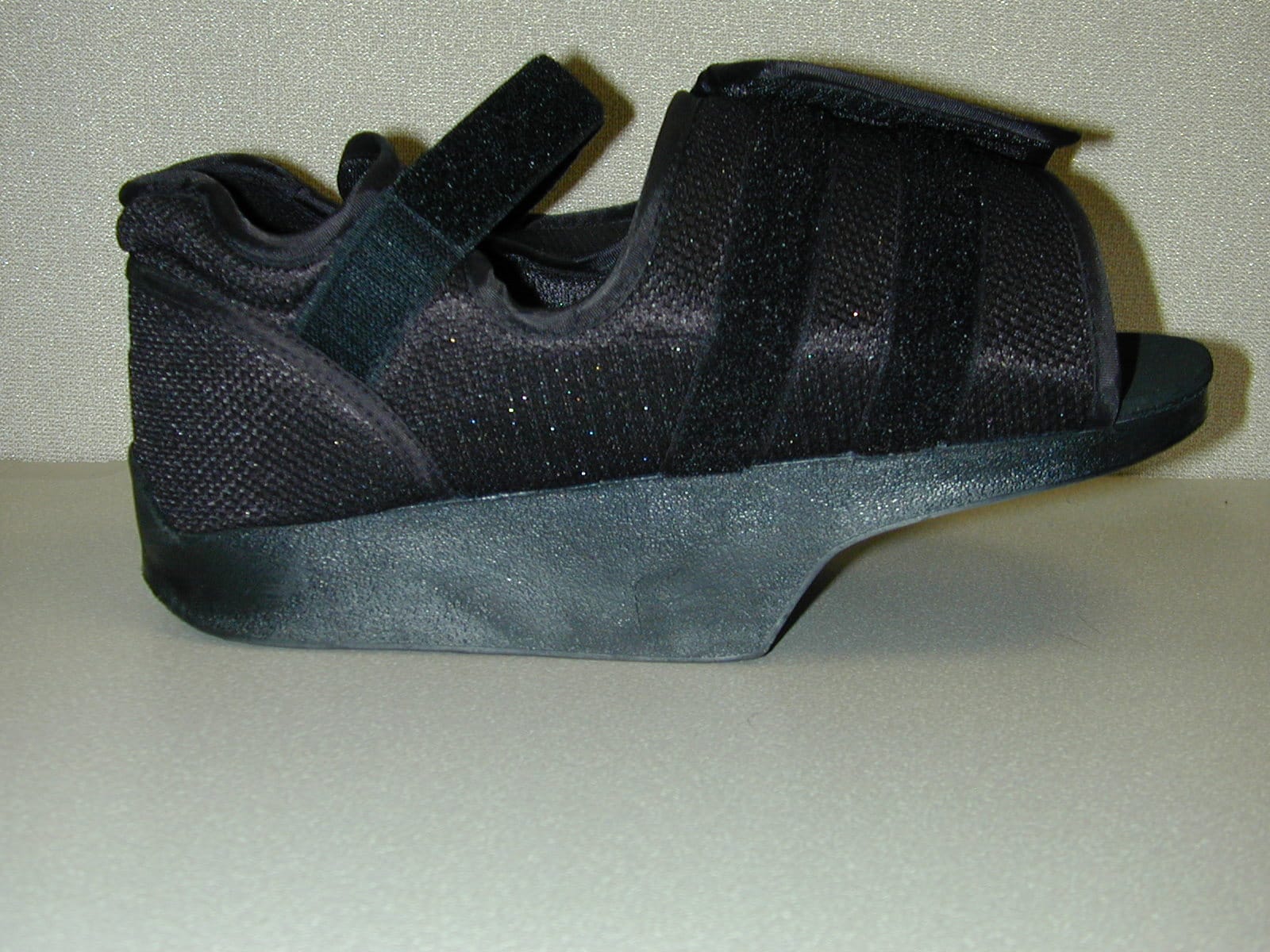
The operation itself was a day-case, so admission at 7.00 in the morning, nothing to eat for a few hours before, and in for the op just before lunch. A spot of general anaesthetic and 45 minutes later,  and I found myself in the recovery room with a large bandage on my foot, and no real pain, which was nice. A quick episode of vasovagal syncope, and consequently a not-so-quick extra hour in the recovery room, followed, before I found myself back in my room eating an incredibly dry ham baguette and drinking litres of water. The physiotherapist came round around mid-afternoon to show me how to walk in my special new idiot shoe, and to show me the best way to climb the stairs (spoiler alert: as little as possible), before the nurse gave me my drug cocktail for the next fortnight (two types of painkillers,  anti-constipation drugs to undo the bunging effect of all those painkillers, and a daily anti-DVT injection to stop me pooling and dying) and sent me on my way. Kath managed to get me to the car and home in one piece, where I promptly flopped on the couch, and stayed there for two weeks.

The surgeon and physiotherapist weren’t joking with their instructions to stay off my feet for two weeks and keep my foot elevated. The time it took to walk to the kitchen to get a drink and walk back was all that was needed to start my foot throbbing, and require a dose of painkillers. The only time I was on my feet during that two weeks for any longer period than that was climbing down and up the stairs every morning and evening, and having a shower. This latter task proved to be… interesting. Under (further) strict instructions to not get the bandage on my foot wet, it was recommended to me to wrap my lower leg up in two bin bags2 and tape up the bags using parcel tape. Needless to say, this procedure became both an awkward and an expensive daily affair. A solution was needed, and my friend James had a solution from his days of a broken ankle-leg thing – the LimbO Waterproof Protector. Oh what a piece of technology! Akin to pulling on a thick, leg-length condom with a neoprene rim, this bad boy laughed in the face of any water than got even vaguely close. A modern day wonderment, the LimbO is. Once I was equipped with this marvel, my showering became much more confident, and far quicker, which helped my poorly foot no end.

Over the course of the two weeks, sporadic swelling and throbbing due to too much hobbling about aside, the pain was minimal. The biggest discomfort occurred around 17.30 each day when Kath administered an injection in my gut to minimise the risk of thrombosis due to being sat down all day (that fucker stung quite a bit). I was far too much of a wuss to be able to administer my own injection…

After my two weeks internment was through, I was called back to the dressing clinic to have my bandage removed. Initially nervous at what may be uncovered, and being unsure as to whether it would need re-bandaging, I put on a brave face as the nurse chopped through the strapping and bandaging, and gave my stinky, manky foot a clean. Lo and behold, it was still in once piece, with a neat 8-10cm scar that was as straight as a die and healing nicely. The surgeon took a look, gave it a bit of a wiggle and deemed me fit to remain unbandaged and newly en-shoed. Joy.

The fun, however, wasn’t over. Whilst I was now allowed to walk a little more (although keeping my foot elevated when sat was still recommended) and to start driving again, I suspect the only reason for this was to aid my transit to the cruel, sadistic physio every week or so. Boy, did that hurt. Whilst she was doing nothing more than merely bending my toe up and down (with some force; the aim was to overcome the stiffness produced by everything knitting tightly back together again), the pain, at least for the first few sessions, was sufficient for me to become light-headed, and to need a bit of a lie down3. The physio worked on my toe for the next couple of months or so, giving me exercises to do at home, such as prancing around on tip-toes, and working my toe’s flexibility during our sessions.

Finally, I was called back to see the surgeon for, hopefully, my 6-month sign-off. He was reasonably happy with my progress, and consequently gave me a clean bill of toe-based health. Which was nice.

So here I am, 241 days after the operation. How’s my body holding up?

  • Movement – I’ve got substantially more flex in my big toe now. Prior to the operation, there was literally (not even figuratively — literally) zero degrees flex upwards in my big toe. Now, there’s probably 30-40 degrees. A normal toe may have anything up to 90 degrees. Clearly, I’m nowhere near where I should be, but my expectations for this were set appropriately by Mr. Harris before the operation. I’m happy with this improvement – my gait is far more normal now, and doesn’t require a strange roll to the side of my foot, which was the thing that was making my ankle, knee and hip sore before.
  • Toe pain – The pain is substantially reduced. I can walk five miles nowadays without any significant discomfort, whereas previously I’d’ve been popping the ibuprofen and moaning for a couple of days subsequent. I do get some discomfort when the weather is cold and damp, but I suspect that’s more to do with the arthritis in the big toe joint that anything else, and that’s something about which I can do nothing.
  • Other pain – The pain and discomfort I used to experience in my hip and posterior due to my wonky gait is as good as gone. This is amazing. I’ve had discomfort all about the lower right of my body for a number of years, and having this operation has seemingly revealed it was all to do with my bloody non-bending big toe. Quite the pleasant revelation.
  • Shoes – An unexpected bonus, but previously I wore the outside of the heel on my right shoe far more than any other part of either shoe, necessitating new shoes far more often than expected. Post op, my shoe wear is back to normal. Take that, shoe companies.

So that’s about it. Once again, your mileage may vary, and check with your doctor yadda yadda yadda, but a cheilectomy seems to have righted most of the wrongs I was experiencing, and I wouldn’t hesitate to repeat the operation if I was in the same situation again. Unless, alternatively, I was offered some sort of bionic robot toe, which I’d take without thinking, obvs.


  1. Usual disclaimers apply: I’m not a doctor, I don’t know anything about your case, so take all I say with a grain of salt, talk to your doctor, please don’t sue me if your toe falls off and your head turns into a pumpkin and your scrote inflates to the size of Belgium. That covers it, I think. 
  2. Don’t worry, I didn’t miss an opportunity to make a ‘double-bagger’ joke. It was my body that was slow, not my razor-sharp wit. 
  3. I have form with behaviour like this: I’ve passed out twice whilst giving blood, and nearly fainted once whilst having a filling at the dentist. 

Macs and Me: Part 1

(This is the first of a nine part, self-indulgent series about  me and Apple Macs. Strap in, and please keep your arms and legs inside the vehicle at all times. You’ve been warned.)

The recent 30th anniversary of the Mac and all the surrounding commentary and reminiscing made me think about my Mac history. Whilst my Mac experiences don’t go back thirty years (only a little over ten, in fact), I thought I’d add my noise to the signal and muse upon my Mac back-catalogue.

2003 – iBook G4

This is where it all started for me. My computing experience until this point had been building PCs and loading them with either Windows (pre-University) or Linux1. My friend James had studied art at University and had come home from there a few years prior with mad Photoshop skills and an old Mac clone machine with System 7 or Mac OS 8 (I don’t remember which) on it2. I was terribly intrigued by its strange, unfamiliar GUI, its love of SCSI-based peripherals (what, you can just daisy chain the printer and the ZIP drive? Amazing…), and the peculiar one-button flipper mouse. How altogether odd.

Sometime in mid-2003, I’d just bought my first digital camera and first iPod (the 3rd generation of what is now called the ‘iPod classic’), and was having no fun whatsoever attempting to sync both of them with a Linux PC. With lingering thoughts of James’ peculiar Mac clone, I decided to take the plunge and pick up a Mac, given its claim of being at the digital hub of one’s life (or some other such nonsense; I forgot the ad campaign of the time). I picked up a couple of Mac magazines to try and suss out which model would be most appropriate, and read a number of columns excitedly mentioning the upcoming iBook G4, apparently a league apart from its predecessor’s G3 processor. It was due out in October 2003, which nicely coincided with a trip to the USA that I had planned. The dollar was at a favourable exchange rate back then, and given the alleged premium we in the UK had to pay for technology in general, and Macs in particular, it seemed a no brainer.

So I found myself in Computer Advantage on the North Tamiami Trail, just north of Sarasota, in November that year, gleefully picking up my new iBook G4. And holy hell, what a machine. It was unlike anything I’d used before. I’d prepared myself for it to handle like the old clone I’d inherited, but it came loaded with the just-released Mac OS X Panther, chock-full of shiny, sparkling gems like Safari and iTunes and Exposé and oh-my-god-did-you-see-the-dock-do-that-magnification-thing. It was an unfamiliar, exotic beast that I instantly fell in love with, if you’ll permit me to be so tragic.

I was still rocking my 3rd gen iPod at that stage, and decided to just plug it into my sparkling new laptop and see what happened. It should be unsurprising to hear that it just worked. Same with the digital camera I was toting. No need to recompile my kernel to get the Firewire drivers working. No need to compile crappy, half-baked open source applications to load songs onto my iPod. It just worked. It was, quite literally, amazeballs.

I loved that machine. Sure, it had a girth to it for a 12″ laptop. My current machine, a mid-2012 13″ MacBook Air, weighs, at 1.34 kg, around half of what that iBook weighed. And yes, the white matt plastic keyboard surround got quite grimy from my fat, sweaty wrists, but these were all matters that were by-the-by. That iBook, even with its plastic case and early-in-its-lifetime version of Mac OS X, instantly converted me, away from bloated old OSes3, or OSes with parts I had to rebuild from scratch every time I changed my digital camera, or uninspiring beige cases with all the aesthetic sensibility of a Brutalist concrete monstrosity in 1970’s Birmingham. It was the meeting of form and function, with neither sacrificed to the other, existing in harmony. The design wasn’t how it looked; it was how it worked. And it worked like a fucking dream.


  1. Around 1997, during my second year at university, my good friend Dave introduced me to Red Hat Linux 4.1 (nope, not Red Hat Enterprise Linux, nor Fedora Linux, even: the original Red Hat Linux), which I initially installed with high amusement and low expectation. I mean, seriously, did you see all those chatty boot messages fly past? And if I want to plug my USB mouse in I have to recompile what? The kernel? If a want to add a Netscape (Netscape!) launcher to my WindowMaker dock I have a edit a text file? A text file? Are you fucking kidding me‽ Eventually, though, it won me over, like it did with many computer geeks back in the day. And with people who didn’t want to either pay for their operating system or pirate one. 
  2. Years later, that Mac clone found a new home with me, during my he-with-the-most-shitty-hardware-wins phase. It proudly sat, switched off, agin an equally proud and equally switched off Sun SPARCstation IPX I’d (legitimately) liberated from a skip at work, until I finally got sick of the clutter and took them both to the tip. Farewell, sweet, yet crappy, princes. 
  3. You don’t know how much it pains me to write something as ugly as ‘OSes’, but it seems infinitely preferable to ‘OSs’ or ‘OS’s’. Sigh. 

The Great 2013 Round-up

Another year, another self-aggrandizing, look-at-my-opinion-on-things, round-up post. And nearly a month late, too. Winner.

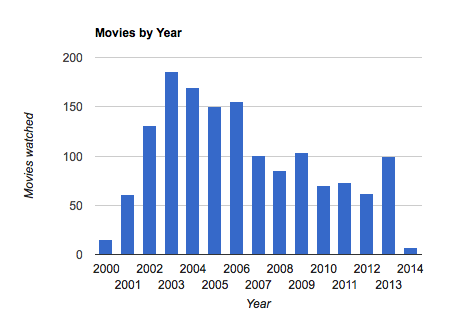
In 2013, I managed to make triple digits in the number of movies I watched for the first time since 2009. After a poor year of only 62 movies last year (0.17 movies/day, or 5.89 days between movies), I managed to hit exactly 100 flicks this year (0.27 movies/day, or 3.65 days between movies) with a last minute, New Years Eve viewing of The Hobbit: An Unexpected Journey. Whilst it’s pleasing to hit the big Three Figures for the year, I’m nowhere near the glory days of the early- to mid-2000s, where digits of 150 were the norm. I even have a graph to prove it:

Movies watched

Highlights of the year:

  • The Hobbit: An Unexpected Journey – Naysayers be damned: I loved this. Sure, I haven’t read the book, so I have no idea how much Peter Jackson ruined the source material, or stretched it beyond its means, but I don’t care. I was more than happy to spend another three hours of my life back in that world, even if it was a tad over-lit and TV show-ey in 3D HFR. Still, it was quite the spectacle.
  • Gravity – Amazing. A pulse-racing, eyeball-popping feast from start to finish. I smell Oscars.

In fact, I probably don’t need to go any further than that. Sure, there were some other great flicks out this year, but I’m a sucker for a spectacle movie, and The Hobbit and Gravity delivered in spades. However, other new (or, at least, new to me) flicks in which I partook and enjoyed include: Zero Dark Thirty (rough in places, but compelling nonetheless), Django Unchained (new to me, utterly enthralling), Captain Phillips (who doesn’t love a good Tom Hanks flick? Losers, that’s who), Saving Mr. Banks (can’t get enough of that Hanks, and Emma Thompson is a dream), Prisoners (the bleakest, most compulsive two hours I spent this year), Argo (Affleck is the new Hanks) and Silver Linings Playbook (I’m also a sucker for a fucked-up love story).

Being laid up for a few weeks in the middle of the year, I managed to find the time to visit a couple of blasts from the past, classics that everyone rolls their eyes at when they hear I haven’t seen them. It quickly became apparent that I’d missed out on some doozies. Butch Cassidy and the Sundance Kid was excellent. The Godfather is every inch a classic, from first to final frame. 2001: A Space Odyssey is a rambling, self-indulgent, preposterous waste of two hours. Bullitt is slow, but redeemed by that car chase.

So not a bad year for movies. As for books, I only managed to get through twelve of them. I don’t need a calculator to work out that that’s only one a month. Disgraceful. My progress was held up with the 2½ months it took me to read Andrew Ross Sorkin‘s Too Big To Fail which was, fortunately, excellent. I made the mistake of reading the first three of the trilogy of five Hitchhiker’s Guide to the Galaxy books, which I fear I’m not the target audience for. I’m sure my 15 year old self would have lapped them up, but the 35 year old me got a touch bored by it all. But the best book by far that I read this year (and which I’ve mentioned before) was A Short Walk in the Hindu Kush by Eric Newby, which played straight into my continuing obsession with all things Afghanistan. It’s as much a story of companionship and a record of mid-20th century British attitudes and humour as it is a travel book, and it’s so much more interesting as a consequence. Lovely.

As for music, my intake of new stuff in 2013 continued its slippery slope down. Highlights were the new Jetplane Landing album, Don’t Try, which was stunning; the new Modern Life is War disc, Fever Hunting, which was very much a welcome return; While A Nation Sleeps, by Boysetsfire, which went some way to atoning for the sins of The Misery Index; Blood Drive by ASG, which is a new one to me, but is, as my friend Matt remarked, right up my street; and finally the new Alice in Chains album, The Devil Put Dinosaurs Here, was a continuation of the post-Staley AIC, and if you don’t mind post-Staley AIC, then this was quite lovely.

So that’s about it. I’m certainly no devourer of new stuff, as I used to be, so my choices tend to be limited and conservative, but no less enjoyed and appreciated as in days of yore.

Review: A Short Walk in the Hindu Kush

‘God, you must be a couple of pansies,’ said Thesiger.

A Short Walk… is the story of a couple of ill-equipped, frightfully British chaps who decided they wanted to climb a remote, as-yet-unconquered peak in the north-east of Afghanistan. The quote above is the final line of the book, uttered by famed explorer Wilfred Thesiger, whom they encounter on their return from their adventure, who catches them in the act of inflating their air-beds.

Whilst their inexperience and naivety leads, as expected, to all manner of difficult and dangerous situations, the story is told with quintessentially British humour and wit. Infinitely readable and most enjoyable, it played right into my current, and bewildering, fascination with Afghanistan. Tragically, whilst reading I attempted to track Newby and Carless’ journey around the Panjshir Valley and through Nuristan on Google Maps, with the help of the crude maps included at the end of the book which, whilst not always successful, made the stories a touch more real and tangible.

If either travel writing or Afghanistan is your thing, read this book.

A Short Walk in the Hindu Kush – Eric Newby